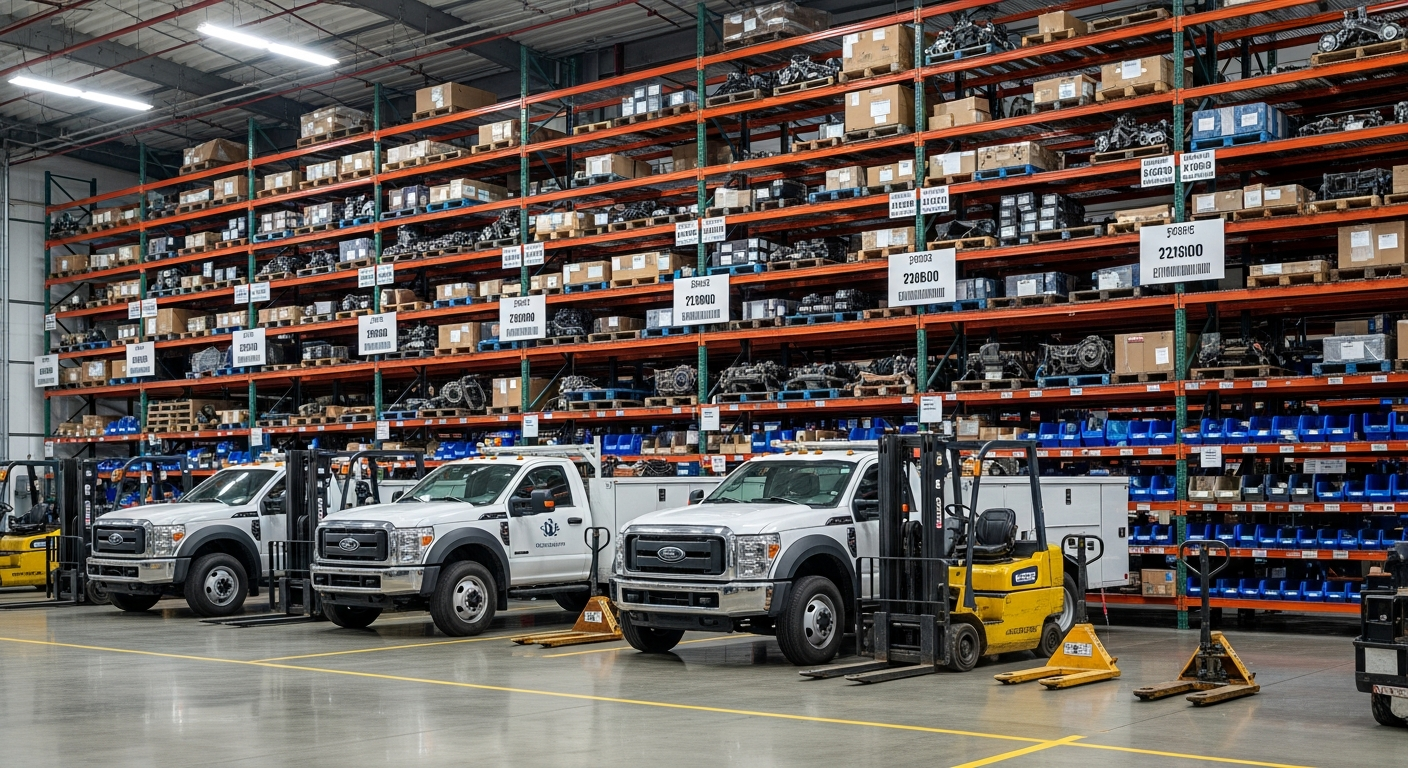
The Hidden Cost of Inventory Chaos in Multi-Truck Operations
For an RV repair operation running two or more service trucks alongside a parts warehouse, inventory management is not a back-office concern — it is a direct driver of profitability. Every mismanaged stockout, every duplicated order, every part used on a job but not billed, and every dollar tied up in obsolete stock is money that should be on your bottom line but isn't.
The numbers are significant. Industry research on fleet vehicle operations shows that vehicle downtime from parts stockouts costs organizations between $448 and $760 per vehicle per day on average, with figures reaching $500–$2,000 per day for specialized service vehicles when lost revenue and emergency labor are factored in. Dealerships and service fleets that don't optimize their parts inventory lose 15–20% of potential parts revenue to stockouts annually. Meanwhile, typical fleet operations carry 15–30% excess inventory — thousands of dollars in capital sitting on shelves in parts that don't move.
The good news: operations that implement structured inventory management systems see dramatic results. Studies of fleet parts optimization show stockout reduction of up to 90%, inventory investment reductions of 25–35%, and annual savings of $100,000–$175,000 per 100-vehicle fleet. Return on investment from inventory software typically runs 200–400% within 12–18 months of implementation.
This guide walks through the exact framework that well-run RV service operations use to get control of fleet and warehouse inventory — and how it connects directly to your work orders, billing, and field operations.
Understanding Your Inventory Problem First
Before building a solution, you need an honest diagnosis of your current state. Most multi-truck RV operations have a version of the same problems, just in different proportions:
- The "I thought we had that" problem: A tech arrives at a job confident they have the part. They don't. It's on a different truck, or it was used on a job last week and nobody updated the count.
- The phantom inventory problem: Your system says you have 4 of something. You actually have 1. The gap comes from parts logged in but not logged out, returns that weren't processed, or damage that wasn't recorded.
- The buried capital problem: You have shelves full of parts that haven't moved in 18 months. They're not generating value — they're consuming storage space and carrying costs while tying up money that could be in faster-moving stock.
- The emergency order problem: Because you don't know what you have until you need it, you end up making expensive emergency orders from local distributors at markup, or shipping costs on overnight freight, multiple times a month.
Each of these problems has a root cause: the absence of real-time, location-specific inventory visibility. You can't manage what you can't see. The entire framework below is built around creating that visibility — first at the warehouse level, then at the truck level, then connecting both to your work orders.
Step 1: Establish the Warehouse as Your Inventory Hub
Every part in your operation should originate from your warehouse before it goes to a truck. The warehouse is your single source of inventory truth. Parts that come in from vendors get received at the warehouse. Parts that go to trucks are transfers, not disappearances. Parts that come back from trucks are returns that need to be recorded.
Getting warehouse inventory under control requires three things:
Physical Organization That Matches Your System
Every bin, shelf, and drawer in your warehouse needs a location designation that exists in your inventory system. A part that's "somewhere on shelf 4" is effectively invisible to your system. When you receive a part, it goes to a specific location. When a tech checks out a part, it comes from a specific location. This physical-to-digital mapping is what makes inventory counts reliable.
For parts that are stored in multiple locations (multiple bins of the same part at different points in the warehouse), your system needs to track aggregate quantity while still logging individual bin levels so cycle counts are manageable.
A Receiving Process That Captures Everything
Inventory accuracy starts when parts come in the door. A receiving process that involves a quick scan of a packing slip and a box dropped on a shelf is a receiving process that creates phantom inventory. Every receipt should be entered against a purchase order, quantities verified against what was ordered, and the system updated immediately. Discrepancies (shorts, overages, damaged goods) should be flagged before stock is put away.
Barcode scanning at receiving dramatically improves both speed and accuracy. A tech scanning a part to receive it takes less time than manually entering a part number and quantity — and eliminates a significant source of transcription errors.
Min/Max Levels and Reorder Points for Every SKU
Every part in your warehouse should have a minimum quantity (the level that triggers a reorder) and a maximum quantity (the target to restock to). These numbers should be based on actual usage data, not guesses. For parts you use frequently, the minimum should cover expected demand during your typical lead time from the supplier. For slow-moving parts, the minimum should be lower and the maximum constrained to avoid dead stock accumulation.
When stock drops to the minimum, your system should alert you automatically — not when the tech shows up to a job and discovers the bin is empty.
Step 2: Give Every Truck Its Own Inventory
Each service truck in your fleet is a mobile warehouse. The inventory it carries is real inventory — it has value, it depreciates, and it needs to be tracked with the same discipline as warehouse stock.
The most effective model is to treat each truck as an inventory location in your system, identical in structure to a warehouse bin. Parts are transferred from the warehouse to the truck when they're loaded. Parts are deducted from the truck's inventory when they're used on a job. Parts are returned to the warehouse (and the transfer is reversed in the system) when they come back unused.
Standard truck stock vs. job-specific pulls: Trucks should carry a standard stock of high-frequency parts — the items your techs use on most jobs, stocked at the truck level as a fixed inventory that gets replenished regularly. Job-specific parts (custom-ordered items or specialty components pulled from warehouse for a specific work order) should be tracked as job pulls — moving from warehouse to truck to job ticket, not to truck stock.
This distinction matters for two reasons: it keeps truck stock counts accurate, and it ensures that job-specific parts always get billed to the right work order.
Truck check-out and restocking process:
- At the start of each week (or each day, depending on your operation), techs confirm their truck stock against the system count
- Discrepancies are resolved before the truck leaves — not discovered at a customer's site
- Restocking happens at the warehouse against the transfer record, not as a "grab what you need" process
- Any parts damaged or lost on the truck are recorded as a shrinkage event so the system stays accurate
Step 3: Connect Inventory Directly to Work Orders
The connection between inventory and work orders is where multi-truck operations either plug the revenue leak or continue to drain money through unbilled parts.
When a technician uses a part on a job, that part should be logged on the work order — not remembered and added to the invoice later. The moment a part is logged on the work order, two things should happen automatically: the part is added as a billable line item on the invoice, and the quantity is deducted from the truck's inventory count.
This real-time deduction is critical. When the deduction happens immediately, the truck inventory stays current throughout the day. When a dispatcher checks truck stock mid-afternoon to see if a tech can handle an emergency call, the count they see reflects parts used that morning — not last night's starting inventory.
The financial impact of this connection is direct. Parts that go on work orders get billed. Parts that don't get logged don't get billed. In a typical RV repair operation running 3–5 trucks, unlogged parts can represent 5–15% of total parts revenue — a significant and entirely avoidable loss.
Step 4: Manage Purchase Orders and Vendor Relationships
Effective inventory management closes the loop on the supply side, not just the usage side. A purchase order system that tracks what you've ordered, when it's expected, and what it cost gives you visibility into inbound inventory that most operations completely lack.
What a good PO process looks like:
- Reorder alerts trigger when stock hits the minimum level — automatically or with one click
- Purchase orders are created in the system before anything is ordered from a vendor, not after the part arrives
- Expected arrival dates are tracked so dispatchers know when parts will be available for scheduling
- When parts arrive, they're received against the PO — not received "loose" into warehouse stock
- Vendor lead times are tracked per SKU so min/max levels reflect actual delivery reality
Operations that manage vendor relationships through a structured PO process typically reduce emergency purchases by 20% or more. Emergency orders — placing an order at the last minute through a local distributor or on overnight freight — typically cost 30–50% more per unit than planned orders. Every emergency purchase you eliminate is a direct margin improvement.
Step 5: Run Regular Cycle Counts, Not Annual Inventory Scrambles
The annual "count everything" inventory approach is one of the most disruptive and least effective inventory practices in field service. Shutting down operations for a day or weekend to count every part in the building is expensive in lost revenue, and the results are outdated the moment they're done because a truck left for a job that morning.
The alternative is cycle counting: a systematic process of counting a portion of your inventory on a regular basis, so every part in your system gets counted multiple times per year without ever shutting down operations.
A simple cycle count approach for a multi-truck RV operation:
- Divide warehouse inventory into weekly count groups — enough groups so every SKU is counted monthly or quarterly depending on its velocity
- High-velocity parts (used multiple times per week) get counted monthly
- Low-velocity parts (specialty items used rarely) get counted quarterly
- Truck inventory gets counted weekly during restocking — each tech verifies their count against the system before the warehouse transfers new stock
- Count discrepancies are investigated and resolved immediately, not accumulated and dealt with at year-end
Operations that run consistent cycle count programs maintain inventory accuracy above 99% — compared to 70–80% accuracy in operations relying on annual counts. That accuracy difference directly affects how much you can trust your stock levels when making scheduling and purchasing decisions.
KPIs That Tell You If Your Inventory Is Under Control
You can't improve what you don't measure. These are the five inventory metrics every multi-truck RV operation should track monthly:
- Inventory accuracy % — (System count matching physical count) / Total SKUs. Target: 99%+.
- Stockout rate — How often a part is needed but unavailable when a job is dispatched. Target: under 5% of jobs requiring a part that's unavailable.
- Inventory turnover — How many times your average inventory is sold and replaced per year. Higher is better; low turnover means excess or slow-moving stock.
- Parts attachment rate — % of work orders with at least one part billed. A declining attachment rate is a signal that parts are being used but not logged.
- Dead stock value — Total value of parts that haven't moved in 12+ months. This is capital that should be liquidated or returned to the vendor.
What Proper Fleet Inventory Management Is Actually Worth
The return on investment case for fleet inventory management software is well-documented. Research on fleet parts optimization consistently shows:
- 25–35% reduction in total inventory investment through better demand planning and elimination of over-stocking
- Up to 90% reduction in stockout incidents through automated reorder alerts and accurate stock counts
- 50% reduction in time spent on parts management through barcode scanning, automated deductions, and digital POs
- 20% reduction in emergency purchases by knowing what you have before you need it
- $100,000–$175,000 in annual savings per 100-vehicle fleet, with ROI of 200–400% within 12–18 months
For a smaller operation — say, 3–5 service trucks — the scale is lower but the proportional impact is the same. A shop running 4 trucks and a warehouse that reduces stockouts by 90%, eliminates phantom inventory, and captures all billed parts accurately is a fundamentally different and more profitable business.
How SymFlow Handles Fleet and Warehouse Inventory
SymFlow's inventory module was built for exactly this type of operation. Each truck gets its own inventory location. The warehouse has its own stock list. Parts transferred to trucks are tracked as transfers. Parts used on jobs are deducted automatically from truck stock when logged on the work order. Low-stock alerts fire when any location — truck or warehouse — hits its reorder point. Purchase orders track inbound stock so dispatch can plan ahead.
Everything connects: inventory to work orders, work orders to invoices, invoices to QuickBooks Online. Parts that go on a job get billed. Parts that arrive from a vendor get received against a PO. The system stays accurate without manual reconciliation at the end of every week.
If your operation is ready to move from inventory chaos to inventory confidence, start a free 30-day trial of SymFlow. No credit card required. Your first work order and your first truck inventory setup can be live the same day.
Sources & Further Reading
- Optimize Spare Parts Inventory for Cost Control — Heavy Vehicle Inspection ($448–$760/day downtime benchmarks, 25–35% inventory reduction stats)
- Critical Heavy Duty Parts Inventory Management: Stock Level Optimization — Heavy Duty Journal (stockout costs, carrying cost benchmarks)
- Fleet Parts Inventory Management: Minimize Hidden Fleet Costs — SimplyFleet (15–20% revenue lost to stockouts, 90% stockout reduction with proper systems)
- Fleet Parts Inventory Management: Optimization Strategies — OxMaint ($100K–$175K savings per 100-vehicle fleet, 200–400% ROI data)
- 7 KPIs for Optimized Spare Parts Management — Heavy Vehicle Inspection / Caterpillar (inventory accuracy and KPI framework)