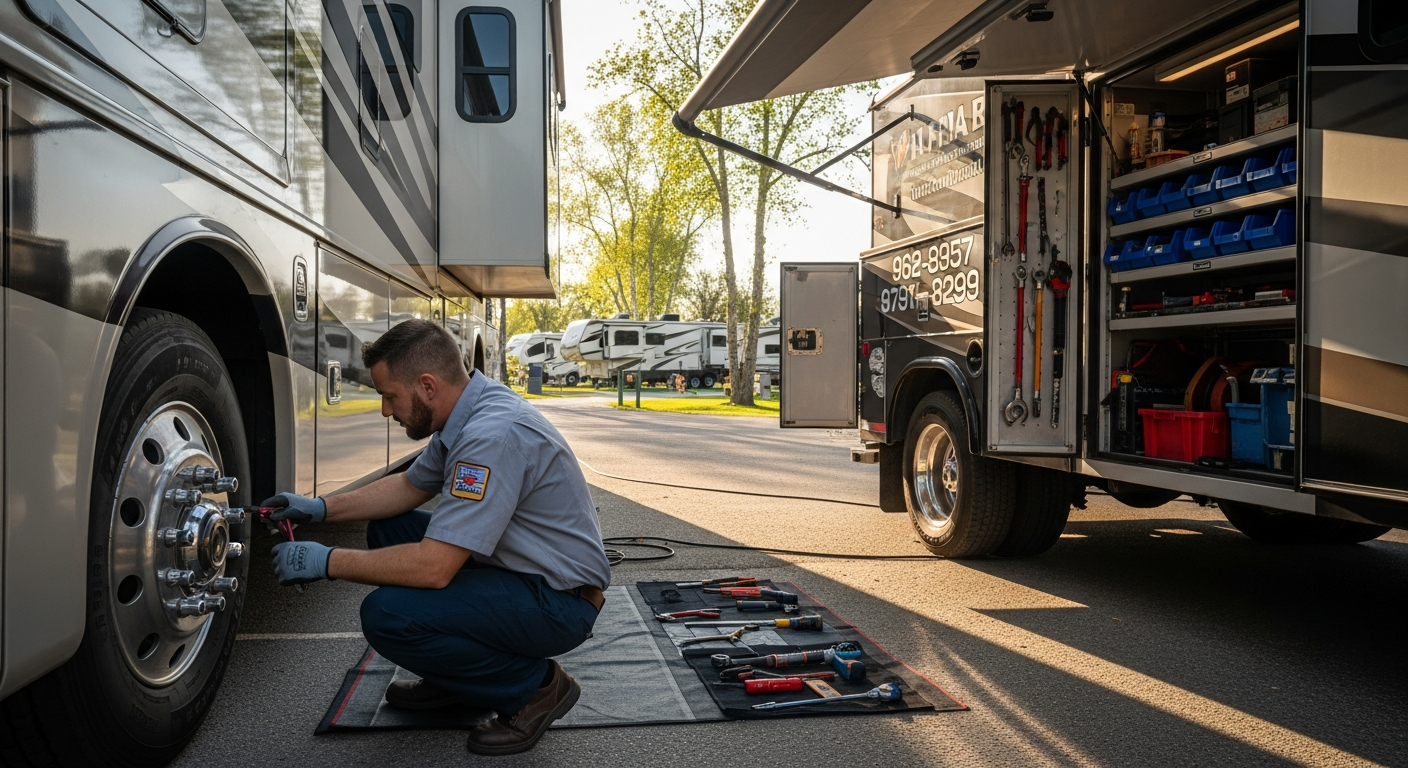
The Mobile RV Repair Reality
Mobile RV repair is one of the fastest-growing segments in the field service industry. The US RV repair service market is estimated at $5 to $12.5 billion in 2025 and is projected to grow to $14–18.7 billion by 2033 at a 4.8–7.2% CAGR. That growth is driven by a simple fact: there are more RVs than ever and not enough technicians to service them.
The Bureau of Labor Statistics counts approximately 17,360 RV technicians in the US as of 2024–2025. The RV Technician Institute estimates the industry needs 20% more technicians than currently exist to keep pace with demand. The result? Dealerships booking 6+ weeks out, average repair cycle times of 34 days, and RV owners actively searching for alternatives. Approximately 80% of RV repairs can be completed outside a dealership — and that's the mobile tech's entire market.
The business model is compelling: lower overhead than a fixed shop, flexible scheduling, loyal customers who refer friends constantly. But the operational challenges are real. You're managing a moving office. Every job is at a different location. You can only carry so many parts. And everything — scheduling, communication, billing, parts tracking — has to happen from your phone while you're kneeling under someone's chassis in a Florida campground in July.
Challenge 1: Managing Your Schedule From the Road
The schedule management problem in mobile RV repair is fundamentally different from a fixed shop. You don't have a dispatcher. You don't have a front desk. When a customer calls at 8 AM wanting to know if you can come out Wednesday, you're either already under someone else's rig or driving between jobs — and you need to make a quick, accurate decision about what you can commit to.
The single biggest scheduling mistake mobile techs make is committing to jobs without accounting for drive time. Back-to-back jobs that look fine on paper turn into a disaster when the first one runs 45 minutes over and you're now 30 miles from your next appointment. Buffer your schedule aggressively — a 30-minute gap between appointments is not wasted time, it's protection.
A digital calendar tied to your work order system lets you see your day at a glance from your phone. New bookings show up automatically when customers schedule online. You can see job location, estimated time, and what parts you need before you leave your house in the morning.
Best practices for mobile scheduling:
- Set a hard stop on how many jobs you'll take per day — don't let optimism overrule math
- Group jobs geographically when possible to reduce drive time
- Always confirm parts availability before confirming an appointment
- Send the customer an appointment reminder the day before — saves you the "did I have that appointment" calls
- Use a status system so customers can see where they are in your queue
Challenge 2: Tracking Parts in Your Truck
Your truck is your warehouse. Unlike a fixed shop that can order almost anything overnight, what you carry in your truck is what you have to work with when you're 40 miles from the nearest parts supplier. Running out of a critical part at a job site is expensive: you either eat the cost of a second trip, or you reschedule the customer and take a reputation hit.
The answer is a disciplined truck stock system. You need to know, at any given moment, exactly what's in your truck and how much of each item you have. Not roughly — exactly. Because "roughly" is how you show up to a job without the fitting you need for the propane line repair.
The best approach is a per-truck inventory list tied to your work order software. Every time you use a part on a job, you log it on the work order — and the system automatically deducts it from your truck inventory. You can see your current truck stock from your phone before you leave for any job. When something drops below your minimum level, you get an alert so you can restock before it becomes a problem.
What to stock in a well-run mobile RV repair truck:
- Common electrical connectors, fuses, breakers, and wire in standard gauges
- Water line fittings and hose clamps in multiple sizes
- Common propane fittings and flex connectors
- Slide-out motor and controller fuses
- Roof sealant, lap sealant, and self-leveling caulk
- Basic appliance components: thermocouple, igniter, pilot orifice
- Leveling system components for common brands
Challenge 3: Collecting Payment in the Field
Payment collection is one of the most awkward parts of running a mobile repair business. You just finished a four-hour job in someone's campsite. You need to collect $800. They don't have a checkbook. Their credit card reader is at home.
The modern solution is a payment link sent by text. The moment your job is marked complete, an invoice generates automatically — every part, every labor entry, already populated from your work order. You hit one button and a payment link goes to the customer's phone. They tap it, enter their card, and pay in under a minute. The money is in your account same day or next day. No awkward conversation, no waiting for a check to clear, no card swipers to charge and carry.
Industry data shows that automated payment reminders improve collection rates by 15–20% and significantly reduce days-sales-outstanding. For a mobile operation where cash flow is the difference between buying stock for next week's jobs and not, that difference matters.
A few rules for getting paid on time in mobile repair:
- Collect a deposit for any job over $500. Send the deposit request via text link before you show up.
- Never leave a job without confirming payment method. If cash, confirm the amount. If card, send the link before you pack up your tools.
- Send the invoice while you're still on site. The customer is right in front of you. There's no better time.
- For ongoing customers, consider a stored payment method so recurring clients can be invoiced and auto-charged without you having to chase them.
Challenge 4: Customer Communication Without a Receptionist
When you're the only person in your business, every inbound call, text, and email falls on you. And every one of those interruptions pulls you out of a job, costs you focus, and slows you down. A customer calling to ask "is my appointment still on for Thursday" while you're diagnosing a slide-out motor is not a good use of either of your times.
The fix is automated communication that keeps customers informed without requiring you to respond to every message individually. When a job is created, the customer gets a confirmation. When you're on your way, they get a heads-up. When the job is done, they get the invoice. When you need to reschedule, one message goes out automatically.
Customers who receive consistent, professional communication become loyal customers. They also refer their friends. The mobile RV repair market runs heavily on word-of-mouth — a customer who feels taken care of at every step is worth far more than just the one job.
Challenge 5: Running the Business Side Without an Office
Taxes, bookkeeping, and reporting are things mobile techs consistently push to the back burner until the end of the year — and then spend a frantic week in January trying to piece together what happened. The answer is systems that capture data automatically throughout the day, so there's nothing to reconstruct later.
Your work orders generate invoices. Your invoices sync to QuickBooks Online. Your payments post automatically. By the time your accountant needs your year-end numbers, they're already there.
Reports should show you the metrics that actually matter for a mobile operation: revenue by week, average job value, parts margin versus labor margin, and how many jobs you completed versus quoted. These numbers tell you whether to raise your rates, whether to hire another tech, and whether a particular type of job is worth taking.
The Tools That Make Mobile Work
A mobile RV repair business that runs on paper, text messages, and spreadsheets is a business that works harder than it needs to. SymFlow was built for exactly this model. Work orders, truck inventory, automated customer communication, Stripe payment links, QuickBooks sync, and mobile-first operation that works offline at any campsite or RV park.
If you're ready to stop running your mobile business on chaos and start running it on systems, start a free 30-day trial — no credit card required, no office necessary.
Sources & Further Reading
- RV Technician Shortage and How It's Affecting Every RV Owner — Cal RV Specialists (BLS technician count, 20% shortage estimate)
- The Truth Behind RV Repairs: Owners Are Waiting How Long? — RV Miles (34-day average repair cycle)
- RV Techs Shifting Gears — Trade Only Today (mobile service demand and technician workforce trends)
- Industry Professionals' Predictions for 2025 — RV PRO (market outlook and service demand)
- RV Repair Service Market Size & Projections — GM Insights ($5B–$12.5B market, 4.8–7.2% CAGR)